Some games I played in 2025: G.I. Joe: Wrath of Cobra
It’s been a funky year, to put it politely. My rambling ass has been spewing thoughts into a dictaphone for the sake of possible blog posts, some of them even about subjects that aren’t beat-em-ups, but having the energy, time, motivation, and other variables required to get things done is a bit of a crapshoot in this weather. Thank you for your patience. In the meantime, more freakin’ beat-em-up opinions.
I’ve groused before about how Shredder’s Revenge sparked a surge of retro-flavoured beat-em-ups, and G.I. Joe came across as one of the more inexplicable. I know there’s a loyal fanbase for A Real American Hero after all these years, but it seemed odd coming out to barely a peep when Hasbro were clearly putting all their chips on the similar Power Rangers entry.
My first thought was — who asked for this? Did Hasbro commission it? Well, this is pretty clearly answered by game designer Kerry Vandenberg in an interview with the Full Force Podcast:
Christopher McLeod: I think a lot of fans have wanted to see G.I. Joe in this style for a really long time, and it just looks like so much fun. Firstly, how did this particular idea come about?
Kerry Vandenberg: It was a pitch to Hasbro. Like most of the community, I thought the same, like, this is a game that should have been made a long time ago. And when we contacted Hasbro they completely agreed with us right off the bat, they had also said that they they wanted this game for a while. We sent them some mock-ups and some concepts and they just loved it and have been loving it the whole time.
And also corroborated by Kerri King, one of the game designers at publisher indie.io (or Freedom Games as it was dubbed at the time), and more bluntly addressing to Lords of Gaming why they jumped on it now.
Randy Rhodes: What are the inspirations to make a G.I. Joe game in this day and age?
Kerri King: Recently there was the Teenage Mutant Ninja Turtles one, so that got the juices flowing. Our dev, Maple Powered Games, we partnered with them and they are amazing; they were the ones that kind of brought the idea to us, and we were like, yes, let’s run with this. We’ve been working with Hasbro to make sure we’re really in tune with everything, that everything’s looking proper.
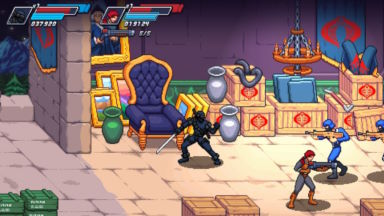
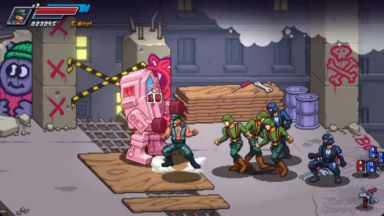
Their hearts were in the right place! It’s just a weird, janky mess of a game, but one that’s hard to express in words. It’s got your basic fundamentals — buttons for light attack, strong attack, blocking and jumping, and different attacks you can perform while dashing or in mid-air.
Doing two light attack and a heavy attack will perform a different finisher to your combo, usually a projectile of some kind, which is a little odd to tether to a combo and not a standalone command. Everyone’s got a unique special they can deploy once they’ve filled up their metre, either by clobbering dudes or picking up floppy discs (??) that drop from downed foes. On paper it passes muster!
It’s just… the properties, man. Things simply don’t behave the way you expect them to, whether it’s down to a lack of cohesive consistency or outright unreliability. Wind-ups and cool-downs, for a start! When there’s light and strong attacks, one would expect the pros and cons to be obvious — weaker attacks come out faster, stronger attacks leave you open to being hit. That’s game design 101 right there.
Instead, most strong attacks are immediately far more reliable…? It’s simply faster and more efficient to spam your strong attack ad nauseam than bother with your light combo. Roadblock is the prime example, as his strong attack just slams dudes into the ground at wicked speeds, knocking them down instantly while also pinning them in place. Compared to his light combo which ends by kicking them across the room, this mitigates the need to go chasing after bodies; if a crowd of enemies are caught in that heavy slam, nothing except a laser shot or sneak attack from the rear will save them.
Meanwhile, Scarlett has such dreadful properties on her attacks that it’s hard to know how to even play her…? All of her moves leave you wide open for retribution afterwards, including her running dropkick, something you’d expect to launch foes a mile away given the wind-up and recovery time on it… but no, it’s just a liability.
She’s also the only one whose aerial attack is a projectile, which… is interesting? It comes across as different for different’s sake than something made to be functional; she’s no Marian from Double Dragon Gaiden, who’s clearly built around toting an arsenal in her dress. You do find machine guns, stun guns, and grenade launches as pickups, to scratch an itch for when you want to just shoot a man.
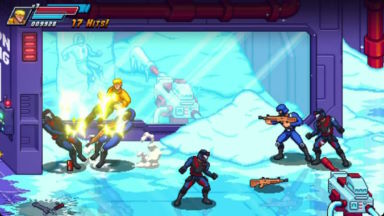
Which admittedly brings me to my unspoken follow-up question from earlier: who asked for a G.I. Joe game, and why make it a beat-em-up? I am the farthest thing from an aficionado on the franchise, but it can’t be argued that big dumb artillery is at least part of its identity. The toys are packaged with like fifty million guns, a lot of characters are defined by what stupid weapon they specialise in, not to mention all the missile-launching vehicles and playsets. Why a genre that’s almost exclusively fisticuffs, and not something a bit more… shooty? We turn again to Mr. Vandenberg:
Kerry Vandenberg: The reason we thought it meshed perfectly with the series is because when you watch the the classic show, the the most high action shots are up close and personal. So we thought, this is perfect, because you’ve got the large scale battles in the background, and then you’ve got our heroes and and Cobra right up close and personal.
I mean, I guess! The fight atop the Statue of Liberty that kicks off G.I. Joe: The Movie is among the most iconic imagery in the series, and indeed, it’s the close-up shots of Roadblock chucking dudes, Scarlett karate kicking, and whatever else that sell the action. Amidst the large-scale battles between two armies, it’s the mano-el-mano stuff that stands out, because of course it would — we’re here for the larger-than-life characters, after all! To reduce its loveable cast to mere army men is probably doing it a disservice.
One of the game’s quirks is that it shows damage numbers on every attack. But… this isn’t a numbers game! It’s not like there’s a level up system to highlight your increase in strength or anything (besides a temporary power-up item) — it just feels like they looked at Dragon’s Crown or Scott Pilgrim and mistook it for a staple of the genre. Enemies don’t have health bars, so I guess it’s a universal stand-in for that…?
Because all it does is make you quickly assess: is this move worth the trouble? In any other game you might have to study your combos and the rate at which enemies die to see what’s more efficient, but here, you see very quickly that no running attack is worth the bother. Why require three button inputs and correct timing for a move that’s clunkier than everything else, with no meaningful benefit?
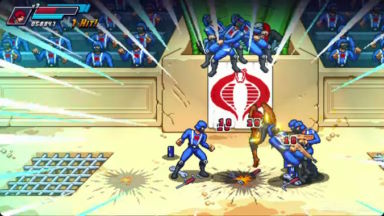
It turns into a race to find “the good button.” Snake Eyes’ heavy is sluggish, but mashing his light combo slices up foes like nobody’s business, and it racks up special metre so he can summon his wolf Timber, who runs around biting fools to build even more metre — I’m pretty certain you can potentially have two Timbers on-screen, it builds that fast!
A good beat-em-up shouldn’t come down to that…! You should have a toolset of moves for a reason, not just because the animators did it for fun! But it’s shocking how everything beyond mashing one of your two buttons just has so little reward.
Aerial attacks are shockingly weak and tricky to hit with, and despite having a dedicated button for blocking, there’s no real ‘juice’ to it; you can’t use it to parry or quickly cancel animations. It negates all damage, sure, but it seems to only exist because avoiding bosses’ combo strings was too difficult with your existing abilities.
Speaking of bosses, the first one is against Major Bludd, and boy, is that perhaps one of the worst introductions to a game I’ve seen. The entire fight is spent playing keep-away, Bludd blasting in a ring around himself to launch you away, and clobbering you with a 3-hit combo if you manage to get close.
It’s a blunt-force lesson in learning to block attacks, with stupidly tight timing on landing your own hits without him clobbering you, then having to close the distance again. Few of the other bosses are ever that abjectly miserable, even if the bar never raises that much higher.
Enemy design on the whole is just kind of funky. Cobra soldiers go down in a few hits, but the moment one is strapped to a CLAW jetpack they become substantially meatier, even if they’re only able to attack with surface-to-air missiles… while other aerial enemies like the Trouble Bubble go down in a single hit.
You do have encounters with heavier artillery, like the H.I.S.S. tank or the bipedal robots, the Sentinel and S.N.A.K.E. — they function more as mid-bosses or siege weapons for crowds to work around, and it’s admittedly easy to see why. Scale and spectacle aside, all they do is perform an extremely telegraphed attack on your X-axis before ambling to catch up again, meaning all you do is sidestep slightly and do punch combos for a minute.
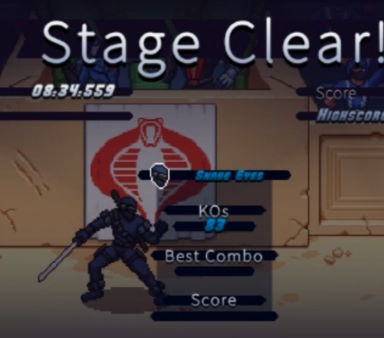
(I can’t vouch for how well the presentation fits the G.I. Joe vibe, but it’s adequately retro… right up until the Game Over or Stage Clear screen hits you with default Windows-ass fonts next to the stylised pixel italics)
The bosses are unique in that they’re heavy hitters of the Cobra army, the size of a regular dude and with only more health, gimmickry, and scripted combos to set them apart from a standard grand. It’s more personal, I guess, even if it lacks the satisfaction of taking down someone twice your size, but they do get long in the tooth extremely quickly, lacking the variety to make the length of their fights all that engaging. This is partially acknowledged in the Full Force Podcast interview:
Kerry Vandenberg: The way that we’ve done the art for the bosses is we were inspired by Mega Man a little bit, or Shovel Knight, where the bosses keep their silhouettes the same. Normally in a beat-em-up, you’d have a big huge boss — and we have some of those also — but we were very specific to keep all the Cobra characters the same size so we could so you could play exactly as those bosses. […] We did talk to them about maybe doing a non-canon DLC where you play as Cobra and they actually win for once.
It shouldn’t be a surprise that I played the game partly for the sake of ripping its sprites — how many games have I reviewed for that reason by now? — so I was acquainted with its graphics and asset storage before I’d even booted the game up. You can tell Maple Powered Games is a tiny little studio, with only four programmers and three artists credited in-house; it’s an alright indie effort, but is clearly a small fish in a big pond. They’ve a lot of passion for the IP, and that clearly shows in Kerry’s interviews.
Kerry Vandenberg: We are very very detail-oriented. We’ve been modelling all the characters off of 360-degree models of all the classic figures. Hasbro supplied us with all their material so that we can make it as accurate as possible; we take almost no deviations.
And I have to commend them, there’s so many details you wouldn’t pick up on unless you were viewing the sprites in isolation! Almost every enemy has a “battle damaged” variant after you’ve socked them a few times, something I would never have noticed if I weren’t wondering why there were so many frames that looked like dupes.
This does perhaps highlight the reliance on bases and templates used in their workload; the same poses and animations are used across the Cobra units and bosses, some adjustments more convincing than others. Scarlett, Baroness and the Night Stalker grunts clearly use the same template, most evident in the absolutely goofy running animations they share.
Some of the characters look a treat, with great animations befitting their abilities and personalities, while others look like edits on par with old sprite comics. I presume Firefly has done cool things to win fans across cartoons and comic books, but his in-game depiction just looks like somebody’s first time learning animation by Frankenstein-ing pieces of pre-existing sprites together.
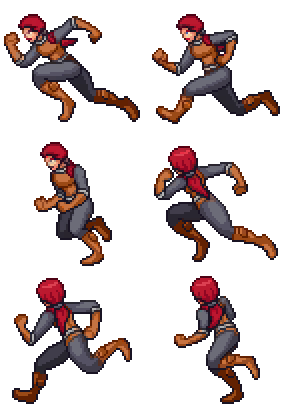
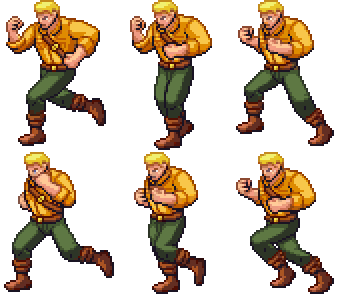
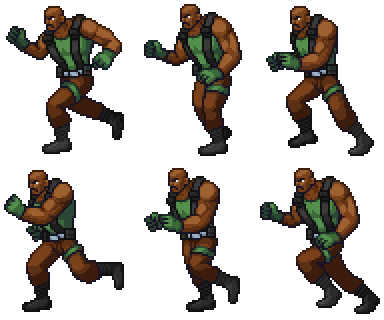
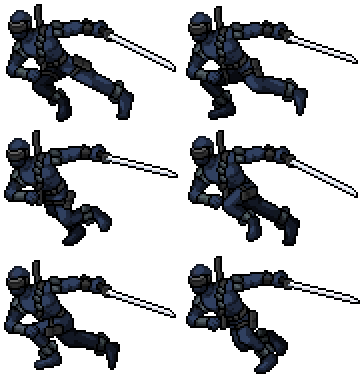
i can’t defend the running animations though. also please ignore roadblock’s tiny tiny head
I respect the moxie, at least. They clearly relished the opportunity to work on Joe, and having to whittle the roster of heroes and baddies down to something feasible must have been an ordeal — they joke that they could make DLC for years just adding in every single character they want on their wishlist.
It’s just a big ask for a sprite-based game is all, especially at this scale. Your standard enemy has 30 frames of animation, some characters bordering on 100, and if everyone ends up using the same punches and idle stances, what does it matter if they’ve all got different uniforms…?
I played up to at least level 10 on normal difficulty for the most part, and it is adequately challenging, if seriously skew-whiff on the difficulty curve at times. You have three lives to finish a level otherwise you get kicked to the start; it does pace out its health pickups satisfactorily, but the health values on enemies is through the roof, and that’s without getting into the Hard and Impossible difficulties.
It all comes back to “why a beat-em-up?” again, though. As aforementioned, turning the series into a straight-forward run-and-gun might not be doing it justice either, but I earnestly think the likes of Shock Troopers, or even Sunset Riders, could serve as a great foundation to work with.
Double Dragon Gaiden has me convinced more games could benefit from a tag system, and the unspoken ethos behind the G.I. Joe cartoon was having friends who’ve always got your back — Shock Troopers has you assembling a party of three from the character roster, each with their own unique weapon, special attack, and close-range capabilities. Why wouldn’t you make that your inspiration?! (I understand we already had our twin-stick shooter craze a decade ago, where you couldn’t take two steps without tripping over a Guerilla Bob or Tiny Troopers or A Bunch of Heroes, but give it a thought!)
Mr. Din, brawler community consultant and pixel artist, helped beta-test the game and offered polite well wishes on its development, but I’m told had to frankly admit there was no hope for fixing the game on its current trajectory without a ground-up overhaul.
He did theorise in his impression video that something akin to Capcom’s Alien vs. Predator or The Punisher would’ve been more ideal — not just in mixing the brawling with baddie-zapping firearms, but even its sprinkling of fast-paced bonus stages, shooting galleries in between the crowd-clearing. I do think it’d still lose the ‘scale’ I so associate with Joe, seeing these dinky 4-inch figures in relation to their big stupid vehicles and command centres and whatever else, but it’s the best accommodation I can imagine if it’s gotta be a beat-em-up.
When Shredder’s Revenge came out to acclaim (even after my own suspicions given my track history with Tribute Games), I was hoping the takeaway would be: people will accept a retro-designed game. If we ignore its lavish animated intro and shockingly star-studded soundtrack, it doesn’t need an AAA budget or high-falutin’ high fidelity, it just needs to be something breezy and confident in its own vision.
Seeing how it sold a million copies in its first week [src: PC Gamer], I guess I can understand everyone and their aunt wanting in on that alleged gravy train, regardless of whether their IP has Ninja Turtles-scale audiences to begin with. It’d just be nice if they asked themselves what they’re bringing to the table, the synergy between this genre and the IP, before they go adding another wannabe product to the pile, wouldn’t it…?
Because lest we forget, Wrath of Cobra costs £20. For a couple quid more, you could get pick up Shredder’s Revenge, or the DLC for another tenner, netting you ten characters, extra modes, a load of great levels, and a kickass soundtrack. Its own quirks and foibles aside, its production quality shows!
Meanwhile, G.I. Joe uses one punch sound effect for the entire game. A random attack will inexplicably bounce you around the screen. Characters are totally mute outside of cutscenes, and Cobra Commander sounds like he’s recording on a 30 year old microphone. I could go on.
I hate making this argument, because games development is tough, and it costs a packet! My wishy-washy sentiment of respecting anyone who ever accomplishes making something hopefully still stands, even if the entertainment I glean from it is perhaps not what was intended. “I want shorter games with worse graphics,” paid more to work less, you’ve seen the mantra. I imagine the Hasbro tax is to blame for the price, because if you’re not a Joe-head, it’s very hard to make an argument for why you’d buy this over any number of better beat-em-ups.
It’s a drag, because I’ve an undue affection for the game. It is undeniably janky and dodgy, wibbly-wobbly to the nth degree, but it’s not often you come across a game that’s just so charmingly skew-whiff, wondering about all the design choices that led to it becoming the way it is.
If you want a solid beat-em-up or something that does justice to G.I. Joe in video game format, this is not the place for it. But it’s akin to Double Dragon IV, which I found myself going back to and mining a lot of (perhaps undue) pleasure from; you can’t be bad to it when it costs a fiver. This doesn’t, unfortunately, which is a little harder to swallow when so much of the game screams in a pleading voice, “we tried!”
(sprite comparison between PC and Nintendo Switch versions)
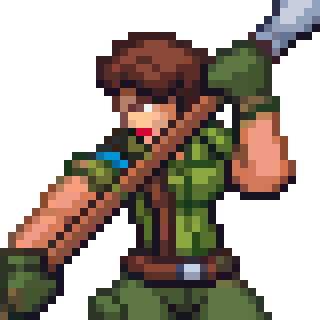
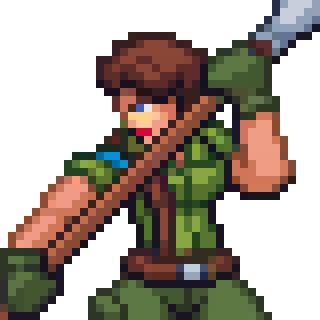
For all this talk of sprites and graphics data, you might be wondering: why haven’t I ripped their sprites, then? Because they’ve got bloody artifacting, that’s why! Rather than clean colour values, there’s smudging and colour-bleed that’s a telltale sign of lossy compression; you can see it clearest on Lady Jaye’s gloves, her belt, and the stray pixels discolouring her eye and nose. If you really want to feel pain, you can run an eyedropper across it and see just how many subtly different shades there are.
I looked into both the PC and Switch versions hoping one of the two would be higher quality, but it’s just two sides of the same coin. It’s possible one could ‘repair’ them by applying a palette index, but organising the fucking things was trouble enough before I realised they were scuffed. I might just zip them up and chuck them out there for others to fix, because I’m throwing my hands up!

[…] up resources for G.I. Joe: Wrath of Cobra, I was curious what reception was like from G.I. Joe fans — lord knows beat-em-up fanatics […]