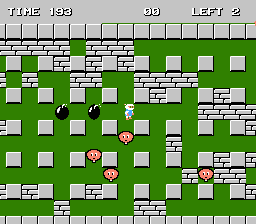
Bomberman
miscellany
Click to enlarge. Art is mostly taken from the original Japanese manual - I think it was cleaned up for the Game Boy Advance rerelease, though I haven't scans that are high-res enough to compare.


Bonus Item origins
A majority of the Bonus Items are references to other Hudson Soft games or iconography.


The Bonus Target and Gordess are objects from Star Force, a space shooter by Tecmo, ported to the Famicom and MSX by Hudson. In their original game, they are destructible objects worth bonus points, the latter of which is extremely rare (and is actually named
Bomberman Special would replace the Goddess with Hachisuke, the Hudson Soft mascot. The Hudson bee would appear as a bonus collectible in other Hudson-developed games, including Adventure Island and Super Mario Bros. Special.
On PlayStation, a Louie icon replaces this item.

The generic bottles of cola (are they a reference to something I don't know about?) were replaced by the Yo-Yo in the PlayStation version, referencing the Hyper Bomber mini-game in its battle mode.


A Famicom, the console the game is being played on. It's, like, meta or something.
Bomberman Special would change this to a BeeCard, a Hudson-developed periphery game format for the MSX that the game was distributed on.

Three BeeCards and the BeePack converter
(src: parape_pope_gugugu)


A self-portrait of programmer Shinichi Nakamoto. The Modern version on PlayStation would update this to his then-contemporary appearance, with a beard and receding hair.


Dezeniman, the protagonist of Dezeni World, a Hudson Soft text adventure for home computers -- see Hardcore Gaming 101.
Bomberman Special replaces this with a clock tower, a tribute to the iconic clock tower at the front of Hudson Soft's headquarters.
The PlayStation version swaps it for a Tekuteku Angel, a "creature-breeding" pedometer device marketed by Hudson around that time; some of its creatures would also appear in Baku Bomberman 2.

American oddities
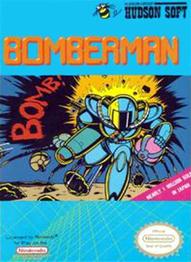
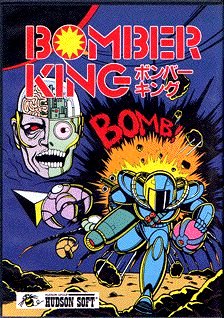
The boxart for the NES version is lifted and edited from the MSX release of Bomber King, for some reason. The American NES release of that game (as RoboWarrior) would use a newly commissioned piece of art instead.

There's reason to believe the American release was pushed way back for unknown reasons. The copyright on the packaging and title screen of this release are dated 1987, suggesting it was intended to be released alongside Lode Runner and Raid on Bungeling Bay circa September 1987.
Computer Entertainer magazine would then cite a September 1988 release date, putting it alongside Adventure Island and Milon's Secret Castle -- something Bomberman is depicted alongside in various advertisements, and even the pack-in poster!
Whatever the case, the game finally slumped onto shelves in January 1989 according to magazine sources. By no means the only early Famicom game with an extremely belated international debut, but it ain't a good look!
● NES
● Game Boy
● PlayStation
● GBA (NES Classics)
● GBA (Bobobo-bo Bo-bobo)
● GBA (Hudson Best)
● Super Bomberman Collection
The versions of Bomberman on Famicom, MSX, Game Boy, and PlayStation are all subtly different from one another, with different requirements for Bonus Items and other minutiae, as detailed in the gameplay page... but for sake of convenience and our mutual insanity, here's a handy table highlighting the big differences.
| TIMER | ENEMY SPAWNS | BOMB MAX | FIRE MAX | INV | KONDORIA | OVAPI | BONUS TIMER | SLOWEST SPEED | SLOW SPEED | MEDIUM SPEED | FAST SPEED | |
| NES | 310 | item | 9 | 4 | 34s | 2000, slowest | 1000, slow | 8s | 1 | 2 | 3 | 4 |
| MSX | 292 | stage | 5 | 5 | 28s | 2000, slow | 1000, medium | 12.7s | n/a | 1.25 | 1.33 | 1.66 |
| BOY | 200 | cycle | 9 | 4 | 17s | 1000, slowest | 2000, slowest | never | 1 | 1.8 | 2.125 | 4 |
| PS1 | 180 | item | 9 | 4 | 30s | 2000, slow | 1000, slow | never | n/a | 1.2 | 2 | 2.4 |
Timer is how many real-time seconds you are given per stage.
Enemy spawn is what factor determines the enemy that generates after bombing a door or item: correlated to the item, a different one per stage, or cycles through enemies on a pattern.
Bomb max and Fire max are the cap for how many Bomb Ups or Fire Ups you can acquire in a standard game.
"INV" is how long the Invincibility power-up's effects last.
Ovapi and Kondoria have different score values and speed between versions.
Bonus Timer is how long a Bonus Item will be available after spawning before it vanishes.
Speeds are measured in tiles per second, roughly calculated on how many frames to move 1 pixel. Bomberman Special and the PlayStation version notably omit the "slowest" speed, bumping Kondoria up to merely slow.
Bomberman Special (MSX)
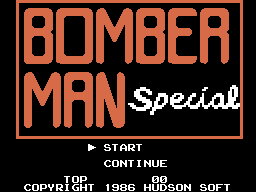
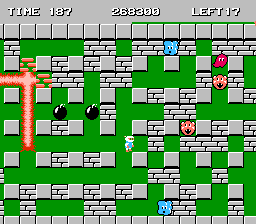

The MSX runs at a smaller resolution and reduced colour palette, turning the green and grey landscape into predominantly black and blue. Enemies have no animation, moving around as static images, and the entire game runs way slower than the Famicom original, despite running at the same framerate.
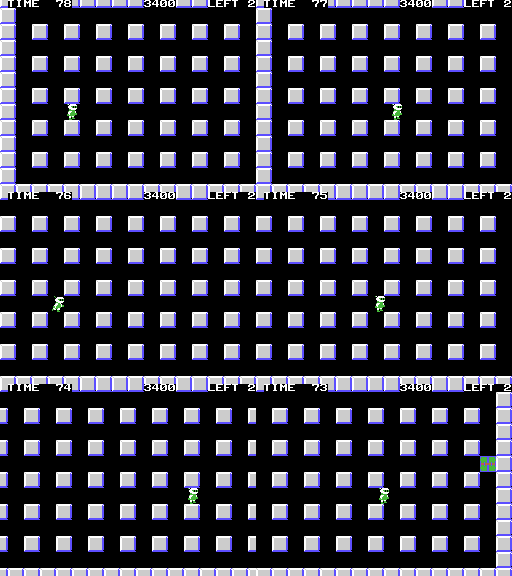
The most egregious sacrifice is that the scrolling camera is removed in place of a flip-screen method, moving once Bomberman is within a certain distance from the screen's edge. If you never thought you could get motion sick playing Bomberman, time to challenge that notion!
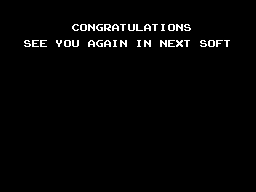
The ending has no graphics and no plug for Lode Runner. Hudson didn't make a port for MSX!
Famicom to NES
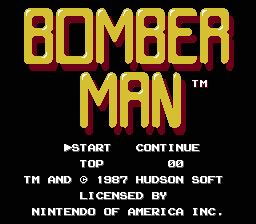
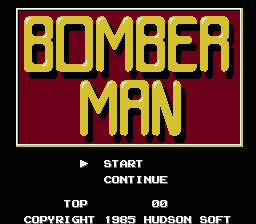
The Japanese version is dated 1985 and features a red border around the logo. The American release drops the border, updates the date and legal jargon, and rearranges the menu options; START and CONTINUE are now aligned horizontally instead of vertically.

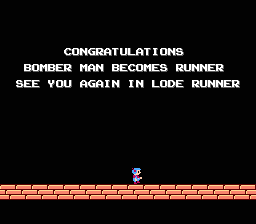
The Japanese version explicitly plugs Lode Runner in its ending. The American version is more vague about it, and a lot wordier to boot.
Bomber Boy (Game Boy)
The entirety of Bomberman is included as a bonus mode alongside a whole new single-player game, and a versus mode. Talk about value for money!

This version has the unique distinction of increasing the size of the playing field as you progress, the camera scrolling to show it in its entirety. A handy concession for the tiny screen, albeit one that renders one of the Bonus Items totally inaccessible. Whoops! See its page for deets.
Bomberman (PS1)
A remake built upon the battle game's engine, eliminating a lot of the older eccentricities like getting stuck on walls while moving 'diagonally' (holding two directions at once).

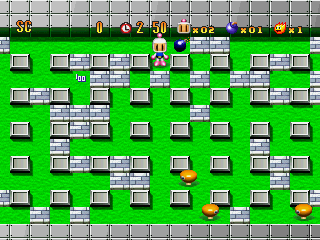
This mode is available in Modern and Retro modes. Modern uses the battle mode's prerendered graphics with unique new background graphics after every 10 stages, and animated intermissions after every second bonus game. Retro applies NES-style graphics to the engine; the sprites are stretched to match how a Famicom game would have displayed on a 4:3 television of the era.
Famicom Mini / NES Classics / Classic NES
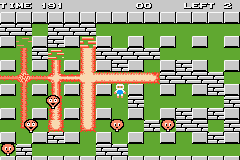
There are many minute differences in the code, enough that when extracted it cannot be run on a NES emulator.
The game runs in an emulator that scales the screen to fit the GBA's resolution.


(NES / Game Boy Advance)
To accommodate this, background graphics have been stretched, and sprites come 'pre-squashed' with a 2-pixel gap in their middles, to minimize potential screen flicker. The palette has been adjusted, presumably to accommodate both backlit and non-backlit Game Boy Advance screens.

All games in this series include a new menu accessed by pressing L and R, allowing you to reset, put the console into sleep mode, and even save your progress.
Bobobo-bo Bo-bobo Bakutou Hajike Taisen
Don't ask me why the entirety of Bomberman is included as an extra in an anime licensed game. Yes, despite the graphical changes, this is Famicom Bomberman and all its 50 stages with their respective items, enemies, and spawns. This is the first version since Bomber Boy to include vertical scrolling to see the entire playing field.
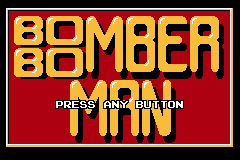

The game is somewhat simplified. Bonus Stages are absent, there is no password functionality, and as far as I can tell, it does not track conditions to spawn Bonus Items (even though their graphics are always loaded into memory).
Enemy behaviour is more in line with how later games behave, ditching the random directional changes. Ballom, Onil, Dall, and Minvo will only change direction upon touching an object, and do not react to Bomberman's presence. Kondoria will actively pursue Bomberman, while Ovapi will change direction every 2 tiles.
Hudson Best Collection

The game data has two changed bytes compared to the Famicom ROM (at 1E4E and 1EB4), but is otherwise identical.
This also runs a similar scaling effect as the NES Classics release, but the only adjustments made are to the soft block and some textual graphics. This results in a 'flickering' effect on hard blocks (that would typically be masked by the "ghosting" on a Game Boy Advance's LCD screen).
Super Bomberman Collection
The code is unchanged from the original. This version features the Japanese title screen, but pastes in the American ending text, seemingly to avoid mention of Lode Runner (which is licensed to Tozai Games as of 2026).

NES / Super Bomberman Collection
The Nakamoto bonus icon has been modified to give him sunglasses.

A debug mode of sorts exists across several versions, marking the location of the exit door and item by showing the soft blocks containing them as partially damaged. Changing address 0094 (NES) or D011 (MSX) to a non-zero value will activate it. Certain passwords can potentially trigger it as well. Kudos to The Cutting Room Floor and MGN3303 for discovery.
Bomberman Special (MSX)

The graphics data includes animation frames for all the enemies that go unused as far as I'm aware.