Bomberman
reference
Japanese manual
story (translated by Pulse Commander)
キミはあのロードランナーのランナーくんの過 去を知っているかい? じつはランナーくんも、 むかしはロボットだったのだ。まだロボットだ ったランナーくんは、ボンバーマンとよばれ、 爆弾を作る仕事をしていた。もちろんほかのロ ボットたちと同じように、悪の手先として地下 迷宮のなかで働かされていたのだ。そんな宙日 がいやでいやでたまらなかったボンバーマンは、 ある日こんなうわさを耳にした。"地下迷宮を抜 けだして地上に出れば、人間になれるらしい。" ボンバーマンはすぐに決心した。なんとか地上 に出て、入間になろう。でも、そう簡単に地上 に出られるわけがないのだ。裏切り者のボンバ ーマンをつかまえるために、たく さんの敵が追いかけてくる。ボン バーマンの武器は、自分で作った 爆弾だけ。はたして地上に出るこ とができるのだろうか。そして、 本当に入間になることができるの だろうか……。
Do you know the history of the runner Lode Runner? As a matter of fact, that runner was formerly a robot. When the runner was still a robot called Bomberman, he was assigned to the job of manufacturing bombs. Of course, as with the other robots, he was forced to work in an underground labyrinth as a minion of evil. With unbearably little light and space, one day Bomberman heard a rumor. "It seems that one who escapes to the surface will become a human." Bomberman was immediately resolved. Somehow, he would make it to the surface and become a human. However, escape to the surface would not be so simple. Many enemies would give chase in order to capture the traitor Bomberman. Bomberman's only weapons are the bombs that he creates. Will he really be able to escape to the surface? And is it truly possible for him to become human?......
American manual
Download here (1.8MB Zip file) (thanks to DragonBomber for scanning this!)
Classic NES Series manual
Download here (1.5MB Zip file) (thanks to DragonBomber for scanning this!)
Ending (NES)
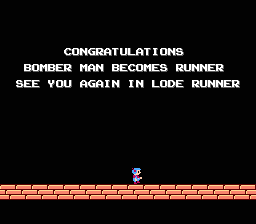
Japanese text
CONGRATULATIONS
BOMBERMAN BECOMES RUNNER
SEE YOU AGAIN IN LODE RUNNER
English text
CONGRATULATIONS
YOU HAVE SUCCEEDED IN
HELPING BOMBERMAN TO BECOME
A HUMAN BEING
MAYBE YOU CAN RECOGNIZE HIM
IN ANOTHER HUDSON SOFT GAME
GOOD BYE
Bomberman runs across the screen. At the halfway point he transforms into Lode Runner; he keeps running and loops around the screen before stopping in the centre.
Ending (Bomberman Special)
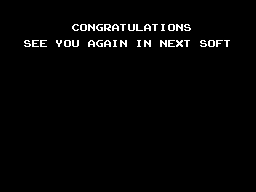
CONGRATULATIONS
SEE YOU AGAIN IN NEXT SOFT
No visuals, no Lode Runner mention, not even a resolution for Bomberman's journey! The price you pay for budget gaming.
Hudson Himitsu Koryaku-ho
Published May 10th 1987. Features a profile on Shinichi Nakamoto, spotlighting his work on Bomberman and Lode Runner.
Super Bomberman Hudson Official Guide Book
Features an interview with Shinichi Nakamoto, sharing his insight on the choices made when designing the game.
16連射のつぶやき
Roughly translated as "16 Shots' Murmurings" or simply "16SHOT", the official blog of
July 8 2024: Explaining the requirements behind some of the Bonus Items, and the logic behind what stages they appear in.
July 9 2024: An anecdote about sharing a password on
急にハドソンのことが語りたくなった (archive)
なかでも印象深く、お世話になったのは中本伸一さん。『ボンバーマン』の隠れキャラで出てくる。彼はマイコンショップのハドソンに入り浸っていた北海道大学の学生だった。当時プログラムした『爆弾男』というゲームをファミコン用に移植した人でもある。
『ボンバーマン』を移植する時間は72時間だったという。寝ずにプログラム書いた。中本さんはガムなどを噛みながらプログラムを書くクセがあって、そのガムも尽きた頃は、あたりに転がっている鉛筆をかじってモニターから目を離さなかったと聞いた。
ひとりが72時間作業して、売上が100万本を超えるソフト。今ではありえない話。
One person who made a particularly strong impression on me was Shinichi Nakamoto. You might know him as a hidden character in Bomberman. He was a student at Hokkaido University who frequented the microcomputer shop Hudson, and ported the computer game "Bakudan Otoko" to Famicom.
It apparently took him 72 hours to port Bomberman, programming all day and all night. Nakamoto had a habit of writing programs while chewing gum, and I'm told when he ran out of gum, he kept his eyes on the monitor by chewing on a pencil instead.
One man coded a game in 72 hours, and it went on to sell over a million copies. A story like that would be impossible nowadays.
Dated January 21 2011. From the blog of Hisakazu Hirabayashi (平林久和), sharing anecdotes about Hudson Soft after hearing the news of its absorption into Konami. Unless it's buried in an old magazine, this appears to be the source of the anecdote regarding Shinichi Nakamoto coding the game in three straight days, a factoid that is often repeated with no citation. To my knowledge, it is not stated anywhere in other interviews with Nakamoto.
Instagram (@frank_zakka)
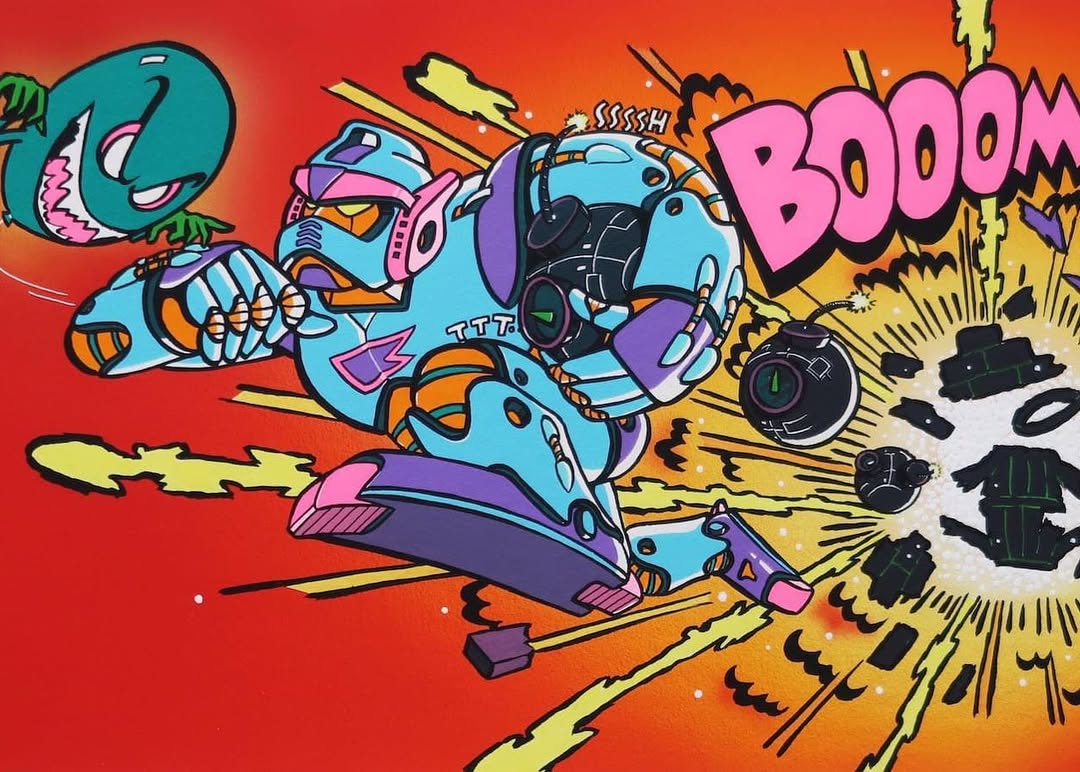
ファミコン・ソフト/ボンバーマン
(ハドソン)
パッケージイラスト他初代はこのイラストで好調だったんですが、パッケージイラスト代だけで〜TVコマーシャル、大量のグッズ、関連ポスター等の無断&無償使用でトラブルに!
誠意ある対応がないので、その後イラスト変更・・・となった訳で・・・。
Posted February 12 2021. Shigeki Hayakawa identifies his work on the game's cover art, and alludes to an incident involving unauthorized reproduction of the art for tie-in materials. He also produced the cover art for Challenger and Lode Runner.
Software Engineer 板垣史彦 Itagaki Fumihiko
FCボンバーマンのSE/音楽制作秘話
ファミコン版《ボンバーマン》のサウンドプログラミングを任される。
SE(効果音)は1つ1つそれぞれの再生プログラムを作り、実機画面に"Sound Testing Room"と表示したモードを作って、確認したいSEをゲームパッドで選んで再生してみることができるようにした。 この仕組みはその後も引き継がれた(…まあ、誰がやってもだいたいそんな感じになったでしょうけど)。
爆弾が爆発する音はなんとしてもリアルにしたかったので、外部のプロダクションからSEライブラリーを借りて、良さげなSEをサンプリングしてDPCMで再生することにした。 が、どんな爆発音を取り込んでみても、ファミコンのDPCMでは、どうも今一つ迫力が出ない。とにかくいろんな音を取り込んでは試し、最終的に「これしかないな」と決めたのは、何の爆発音でもなくて、実はライオンの咆哮。これをわざとレベルオーバー気味にサンプリングすることで、あの音ができた。
BGMやジングルは外部の方に発注しようということになり、紹介された音楽家が竹間淳氏だった。 ゲーム音楽を発注するのはハドソンにとっても初めてのことだったし、また竹間氏も、ゲーム音楽を手掛けるのは初めての試みだったが、 氏はファミコンの貧弱なPSGの特性をよく理解した上で、我々の期待をはるかに超える傑作を生みだし提供してくれた。 ボンバーマンのあの名曲・名ジングルは、かくして誕生した。
僕は竹間氏から受け取った楽譜やデータをファミコンのプログラムと結合して再生する仕事をしたが、実は1つ、ミスを犯した。 タイトル画面の音楽は一部、竹間氏の意図と半音違ってしまっている。僕が楽譜を読んでデータ化する際に、調号とナチュラル記号の関係を取り間違えてしまったのが原因だった。 実際にファミコンで再生して竹間氏に聞いてもらった際、竹間氏はすぐにそれを指摘されたが、その時点では、もう修正は不可能だった(たぶん、すでにゲームカートリッジの製造過程が進行していたため)。 僕は青くなったが、竹間氏は「まあまあ、いいでしょう」と寛大に許してくれた。
竹間氏にはその後もたくさんお世話になった。YAMAHAのMSXに載っていたアプリを使って曲データを制作していただき、そのデータを受け取ってコンバートする流れもできた。
The secret story of Famicom Bomberman's sound production
I was in charge of sound programming for the Famicom version of Bomberman.
I created the sound playback program, and even a "Sound Testing Room" allowing users to select and play sound effects using the gamepad. This continued to see use from other teams (though I figure no matter who made it, the results would have been pretty similar).
I really wanted the bomb detonation to sound real, so I borrowed a sound effects library from an external production company to sample a good sound to play in DPCM. No matter what sounds I tried, the Famicom's DPCM just wasn't powerful enough to do them justice. The sound that made me go, "this is our only candidate" wasn't an explosion, but a lion's roar, which I deliberately sampled over-level.
It was decided that the music were to be outsourced, so musician Jun Chikuma was brought in. It was Hudson's first time commissioning music, and Chikuma-san's first time making music for games, but she had an excellent understanding of the Famicom's weak PSG, and created masterpieces that exceeded our expectations. We have her to thank for Bomberman's iconic jingles.
My job was to combine the sheet music and data from Chikuma with the Famicom's sound program, but I actually made one mistake: A portion of the title screen music is a semitone off from what Chikuma instructed. When digitizing her sheet music, I had mistaken the relationship between the key signature and natural symbols when I was reading the score and converting it into data. When it was played on Famicom and Chikuma-san heard it, she immediately pointed it out, but it was too late to correct it (probably because the cartridge manufacturing was already underway). I turned pale, but she generously forgave me, saying "it sounds fine to me."
Chikuma continued to help me a lot after that. She helped me use software on the Yamaha MSX to create song data, and could receive and convert it for use elsewhere.
A timeline of Fumihiko Itagaki's career, with anecdotes from his time at Hudson Soft and contributions to Bomberman.
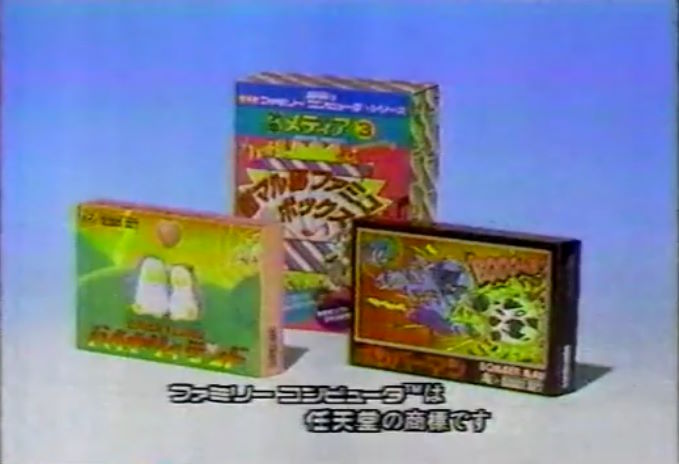
TV commercial (Japan)
ゲームは爆発だ!スカッと快感! ハドソンのダイナマイトゲーム、ボンバーマン。 君はロードランナーに変身できるか?
A 30-second advertisement for Bomberman, Binary Land, and Hudson's
A 15-second variant omits the Lode Runner spoiler, the Binary Land segment (reducing it to an inset bubble), and the Famicom Box entirely.
Family Computer Magazine
Issue 4 (April 10th 1986): Features two pages of reader-submitted Bomberman glitches and oddities are included as part of the Super Ultra Technique 50 feature (超ウルトラ技50).
Issue 5 (April 18th 1986): Features a single page of reader-submitted glitches and oddities are included as part of the Super Ultra Technique 50+1 feature (超ウルトラ技50+1).
Issue 6 (>May 2nd 1986): Features six pages of reader-submitted glitches and oddities are included as part of the Super Ultra Technique 50+1 feature (超ウルトラ技50+1).
Monthly LOGiN
The March 1987 issue features a two-page spread on the Toshiba Rupo, and as of this writing, the most info we've got on the version of Bomberman for it.
Micom BASIC
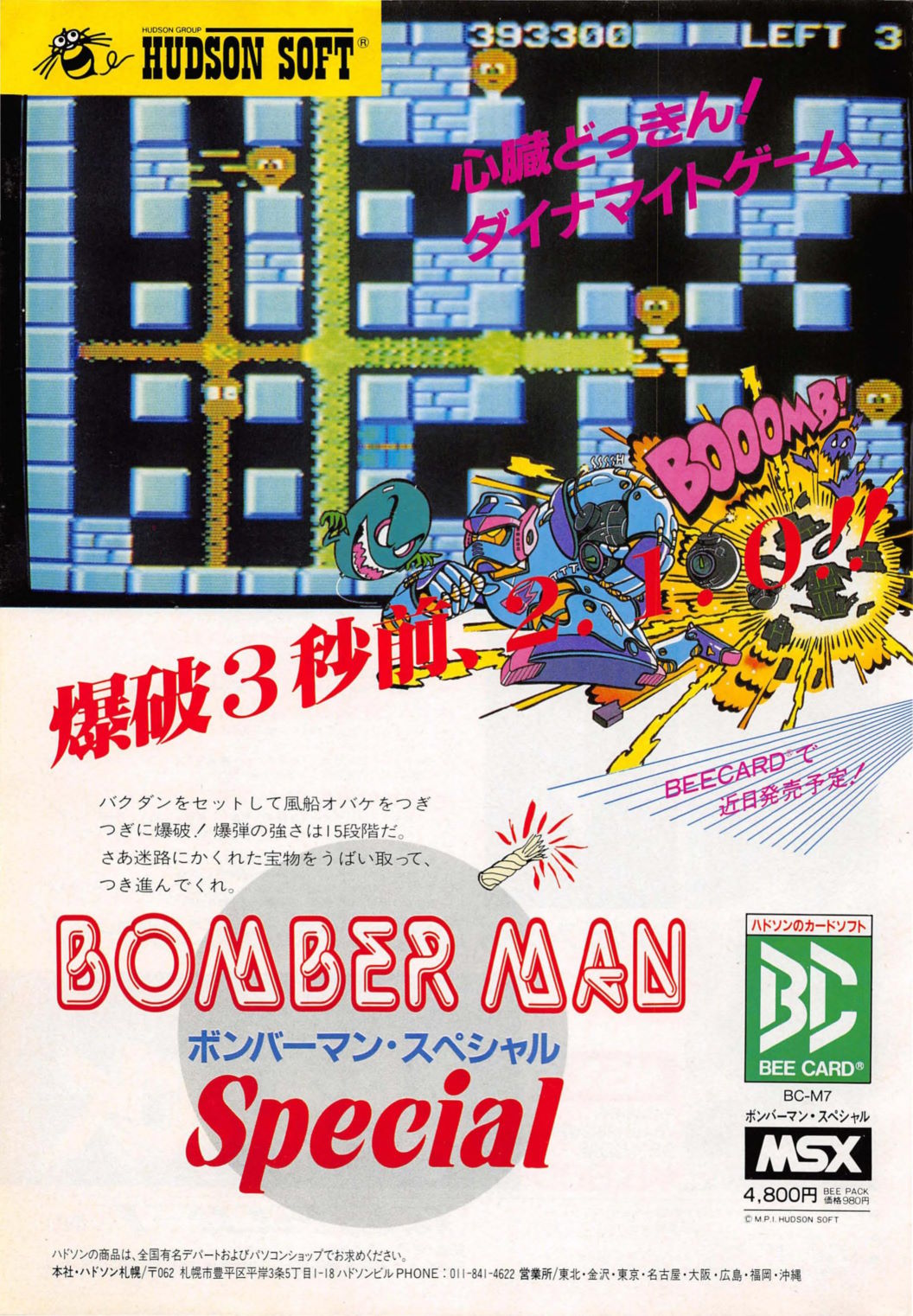
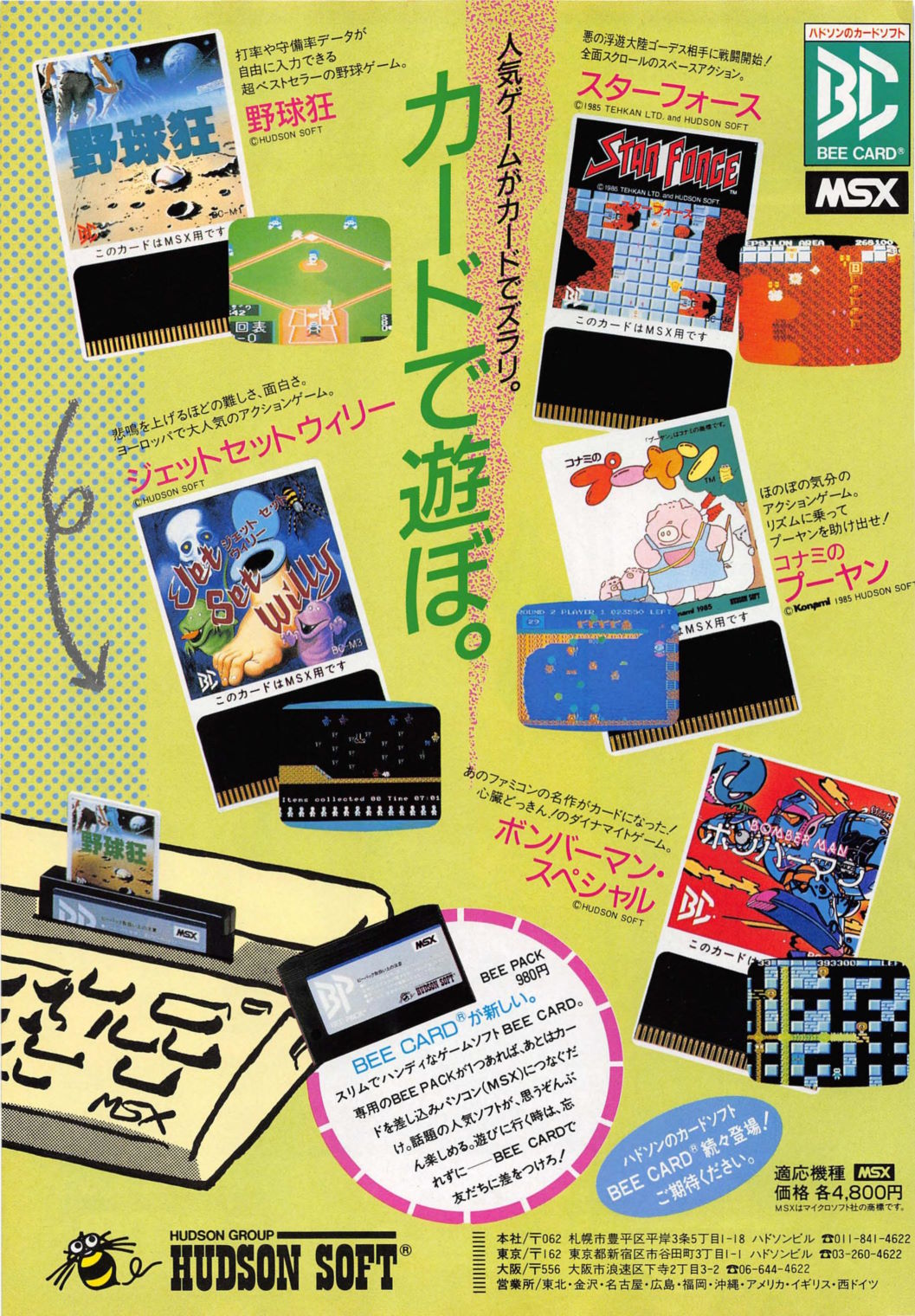
April 1986: Includes a full-page ad for Bomberman Special, which also appears in the May 1986 issue. Scans can be found at Archive.org.
July 1986: Advertised alongside Pooyan, Star Force,
以前発売されていたゲームをディ スク用に再販するもの。 爆弾を置いて敵を全滅させるのが目的。 使用メモリの少ない名作が500円で入手できる点がうれしい。
A previously-released game reissued on disc. The objective is to place bombs and destroy all enemies. You can pick up this low-memory classic for just 500 Yen.
June 1990: Source of the Famicom Disk System version's release date. Scanned by ozidual at the Internet Archive.
Marukatsu Famicom
Issue 3: Dated June 27th 1986. The "Hudson Programmers' Game Collection" (ハドソンプログラマー別 ゲーム作品集) feature spotlights Shinichi Nakamoto and others, calling attention to his self-insert in Bomberman, as well as his work on Lode Runner, Star Force, and Pooyan.
The Games Machine
Bomberman: You may be a robot now, but if you can escape from Earth's core you'll finally get that human form. So blow up anything that bars your path!
Issue 12: Cover-dated November 1988. Bomberman is advertised alongside Milon's Secret Castle and Adventure Island as newly-released Hudson Soft USA products. Likely ad copy lifted from a press release; this is a British publication, none of these games saw release in Europe at that time!
Game Player's Nintendo Buyer's Guide Vol. 1 No. 1
Dated March 1989. An advertisement dated 1988 promotes Bomberman alongside Adventure Island and Milon's Secret Castle.
Nintendo Player's Guide Top Secret Passwords
TITLE
Bomberman
COMPANY
Hudson SoftRELEASE
DATE
Jan. '89CODE
TYPE
PASSPASSWORD
OR CODE
JDNMKLGJDJGGCPOLOMNF ► Level 50GAME
TYPE
Maze Act.
Dated 1992. Another source for the US release date.
Famicom Mini page
Japanese promotional site with a tiny page for each game. Nothing remarkable.
NES Classics site (dead)
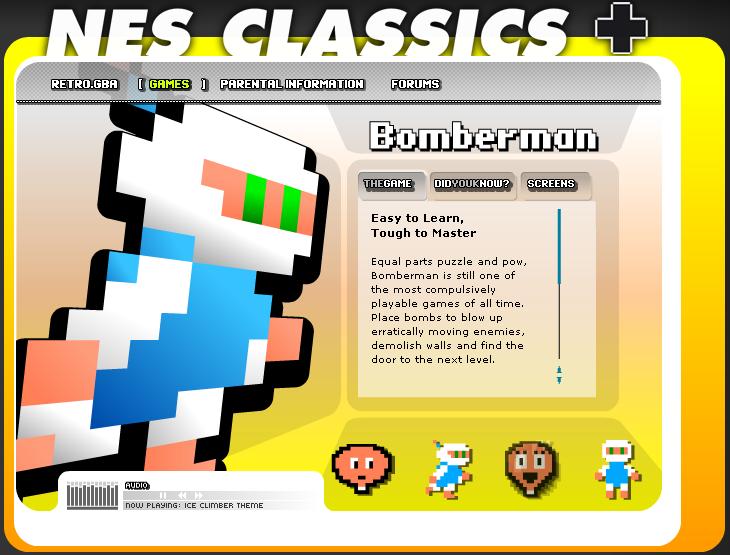
Flash site promoting the first wave of NES Classics games, each one getting a two-paragraph description. It also plays disgustingly-short loops of the games' music that I dare you not to get agitated with within seconds, even fans of chiptune.
Nintendo.co.uk page (dead)
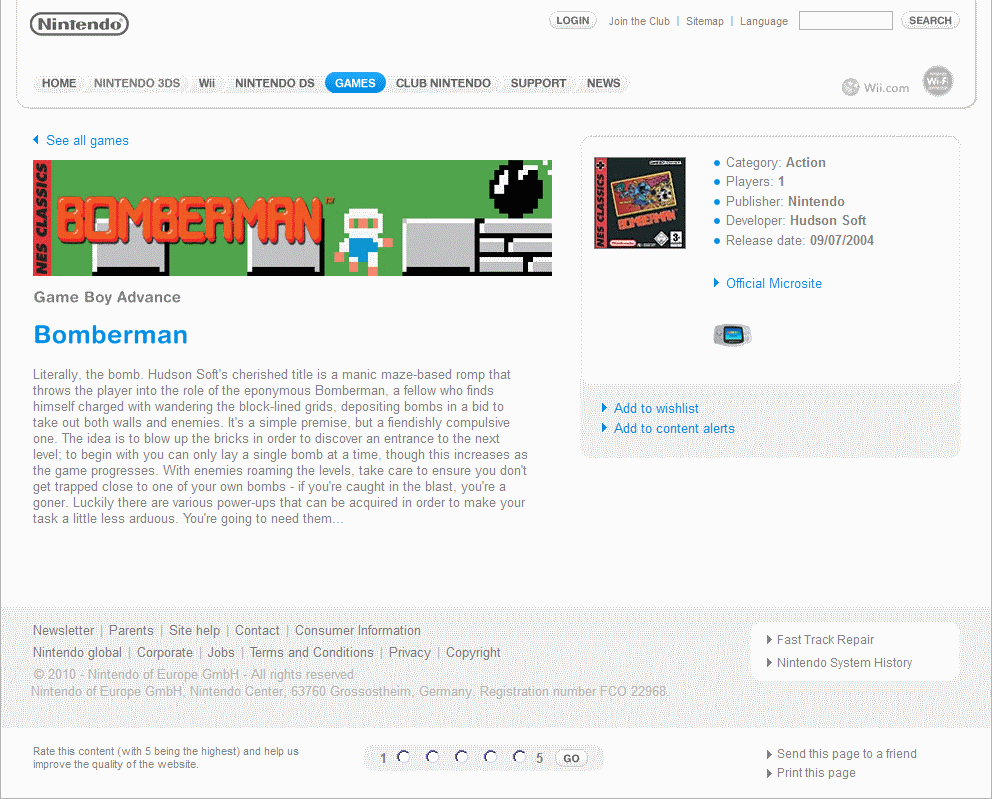
Literally, the bomb. Hudson Soft's cherished title is a manic maze-based romp that throws the player into the role of the eponymous Bomberman, a fellow who finds himself charged with wandering the block-lined grids, depositing bombs in a bid to take out both walls and enemies.
A promotional site that, to me, can't seem to decide whether to make the game sound way more exciting, or just tell it like it is.
Hudson Game Navi
爆弾で敵を倒す迫力溢れるアクションゲーム。子どもだけでなく、お父さんのストレス解消に役立つと話題になった。人気はその後の対戦型に引き継がれる。
An exciting action game about defeating enemies with bombs. Became notable as a stress-relief not just for children, but their parents too. Its popularity carried over to subsequent, more competitive instalments.
1101.com: 『ボンバーマン』当選者発表!
Shigesato Itoi's website. A contest was run for the first volume of Famicom Mini releases, awarding a Game Boy Advance SP signed by Shigeru Miyamoto and one of the ten games, to whoever won said game's respective contest. For Bomberman, the challenge was to describe the sound an unusual object would make when it explodes. Takahashi Meijin judged the entries.
Nanikore Chinhyakkei
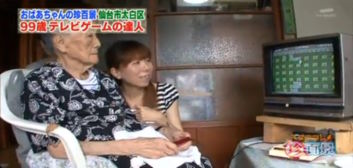
A Japanese variety television show, literally translated as "What's This? 100 Curious Sights", showcasing interesting stories from across the country.
The July 20th 2011 episode [src] featured a highlight titled "The 99 Year Old Video Game Master" (99歳のテレビゲームの達人) on
This story was recapped on the show's official website, and after the video was shared online, saw coverage on a variety of English language sites, including the UK Official Nintendo Magazine blog.
Computer Entertainer
August 1988: Bomberman's release date is scheduled for September.
October 1988: Bomberman's release date is pushed forward to First Quarter 1989.
December 1988: Bomberman's release date is scheduled for January 1989.
BOMBERMAN (★★ / ★★1/2) is a maze game from Hudson Soft in which Bomberman, a robot engaged in the production of bombs at the center of the Earth, attempts to make his way to the surface and freedom. In each of the many maze levels, Bomberman has to avoid enemy characters while setting bombs to explode and blast away portions of brick walls. Hidden behind some wall sections are "power-up" panels and the single exitway to the next maze level. Each time Bomberman loses a life to an enemy or because he's too close to an exploding bomb, he starts the same maze level over again with a different pattern of brick walls. As a result, it is difficult to discern any of the repeating patterns that typically turn maze games into memory tests. Despite the avoidance of repeating patterns, however, this is not the sort of game that's likely to bring gamers back for many playing sessions. Graphics are extremely simple, offering little visual appeal. The game itself is only mildly addictive at first, but we soon became bored with it. (Solo play; Password feature.)
Not recommended. (MSR $44.95)
Review from the March 1989 issue, alongside Robowarrior.
Nintendo Power issue 181
Although the Bomberman franchise has recently branched out into multiplayer tournaments and adventure games, it began in 1985 (and was released in 1989 for the NES) as a single-player action-puzzler. While negotiating a brick grid maze, it's your task to plant and detonate bombs to defeat enemies and break through bricks. The game is very simple but provides quite a challenge and tons of explosive fun.
CHRIS: ★★
GEORGE: ★★★1/2
JESSICA: ★★★
SCOTT: ★★★
STEVEN: ★★★
Dated July 2004. Review of the NES Classics version; score averages to 2.7 stars out of 5.
GameSpot review
However, a Bomberman game without multiplayer is hardly a Bomberman game at all. So while this may be a nearly perfect port of the original NES game, that game really wasn't very good to begin with.
Review by Jeff Gerstmann, dated June 8th 2004. Rated 4.9 out of 10.
PLAY issue 32
Bomberman might not have quite its usual appeal without its multiplayer component, but there's no denying that it provides a good time anyway. What Bomberman lacks in intensity and level design (and box art!) it makes up for with its trademark unique gameplay mechanics. The added battery save is also much appreciated.
Cover dated August 2004. Review by Chris Hoffman, awarded a B-.
There are no in-game credits.